
Ealing removed more than 1,700 vehicles in a year, nearly 200 from housing estates. One owner paid £560. Removed cars go to Wokingham or St Albans.
Ealing Council has removed more than 1,700 vehicles from streets and housing estates in the past year, including nearly 200 from council estates. The figure comes from the council’s own account of a pilot scheme that started in September 2025 and is now being lined up for a permanent replacement.
The case it used to illustrate the scheme is worth reading closely, because it shows what removal actually costs. A Range Rover had already been given a penalty charge notice for parking in a controlled parking zone without a permit. When officers came back, the ticket had gone and so had the number plates. The council says its parking team identified the vehicle anyway and had it towed.
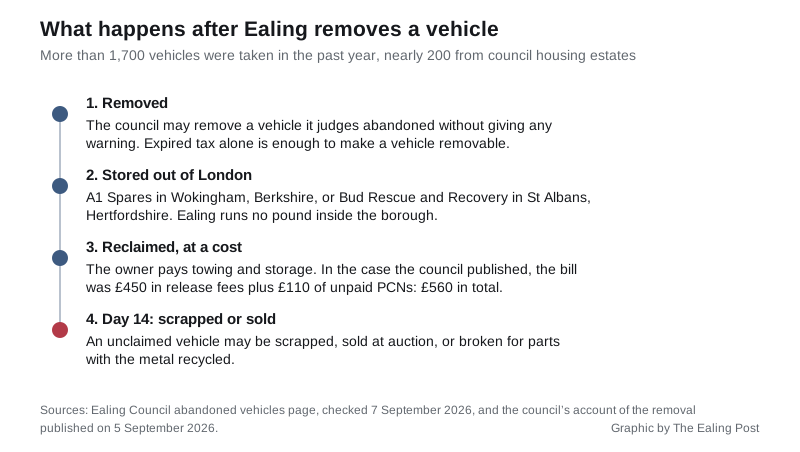
Getting it back cost £560: £450 in release fees and £110 in unpaid penalty charge notices.
What makes a vehicle removable in Ealing
The council’s own abandoned vehicles page lists seven things that can mark a vehicle as abandoned:
- no owner listed with the DVLA and no tax
- it has not moved for a long time
- it is badly damaged or unsafe to drive, for example flat tyres, missing wheels or broken windows
- it has been burnt out
- it has no number plate
- the number plate does not match the vehicle identification number
- its tax and MOT have both run out
Two lines on that page matter more than the list. The first is that expired tax alone is enough: “if the tax on a vehicle has expired, the vehicle may be removed from the road”. The second is that the council may remove an abandoned vehicle without giving a warning.
The council also states the opposite for the benefit of neighbours. A vehicle that is badly parked, or that does not belong to anyone living on the road, is not abandoned and will not be treated as such.
The rules are the same on a housing estate
Nearly 200 of the removals were from council estates, and the council spells out that estate parking is governed by the same standard as the public highway. A vehicle has to have valid tax, MOT and insurance, be in good working order and be displaying its registration plates.
Two extra restrictions apply on estates:
- Commercial garages are not allowed to operate there.
- A vehicle with a statutory off-road notification cannot be parked there. Declaring a car SORN does not make an estate bay a legal place to leave it.
Your car goes to Berkshire or Hertfordshire
This is the part most people do not find out until it happens. Ealing does not run a pound in the borough. Vehicles it takes away are stored by one of two firms, both well outside London:
- A1 Spares in Wokingham, Berkshire, roughly 30 miles west
- Bud Rescue and Recovery in St Albans, Hertfordshire, roughly 20 miles north
The clock then runs fast. If nobody claims the vehicle within 14 days it may be scrapped. The council says unclaimed vehicles are sold at auction or broken up, cleaned of rubbish and fluids, sold for parts, or sent for metal recycling.
The release fee is not in the published tariff
We checked Ealing’s fees and charges schedule for 2026-27. It sets out what the council charges for parking permits, penalty notices and fixed penalties, but it carries no removal, release or storage tariff for towed vehicles. The £450 in the Range Rover case is the council’s figure for what that owner paid, not a rate you can look up before it happens.
What the schedule does publish is the penalty side:
| Charge | 2025-26 | 2026-27 |
|---|---|---|
| Fixed penalty, abandoning a vehicle | £120.00 | £124.56 |
| Fixed penalty, nuisance parking | £101.70 | £105.56 |
| Penalty charge notice, higher rate | £130.00 | £130.00 |
| Penalty charge notice, lower rate | £80.00 | £80.00 |
Penalty charge notices are frozen. The two environmental fixed penalties rise by 3.8%.
What the council says
Councillor Dominic Moffitt, the cabinet member for climate action, said abandoned and unroadworthy vehicles “take up valuable parking spaces, make neighbourhoods look neglected and can attract anti-social behaviour”.
He said the 1,700 figure “shows the scale of the problem and our determination to tackle it”, and that the council will keep working across the borough to identify and remove vehicles.
The council has not published a breakdown of the 1,700 by town or by ward, nor how many of the removed vehicles were eventually reclaimed rather than scrapped. We have reported the figures it has released.
What it means for you
- If your car’s tax has lapsed and it is parked on a road or an estate bay, it can be taken without warning. Check the status on the DVLA vehicle enquiry service before you leave it another week.
- A SORN does not protect a vehicle parked on a council estate. It has to be off the public highway and off estate land.
- If your vehicle has gone, assume the pound is in Wokingham or St Albans and act inside 14 days. After that it may already have been scrapped.
- Missing or mismatched number plates are on the council’s list in their own right, so a car waiting for replacement plates is exposed.
- To report a vehicle you think has been dumped, use the council’s report form or the Love Clean Streets app. The council can also remove a vehicle from private land, including a driveway, if the landowner asks and says so in the report.
If you are working out where you can legally leave a car in the borough, our parking in Ealing page covers permits, zones and visitor parking, and Ealing roadworks and travel covers the closures and suspensions that move parking around week to week.
Sources
- Around Ealing, Range Rover towed after plates vanish, 5 September 2026
- Ealing Council, Abandoned vehicles, checked 7 September 2026
- Ealing Council, Fees and charges schedule 2026-27 (PDF)
Have your say